

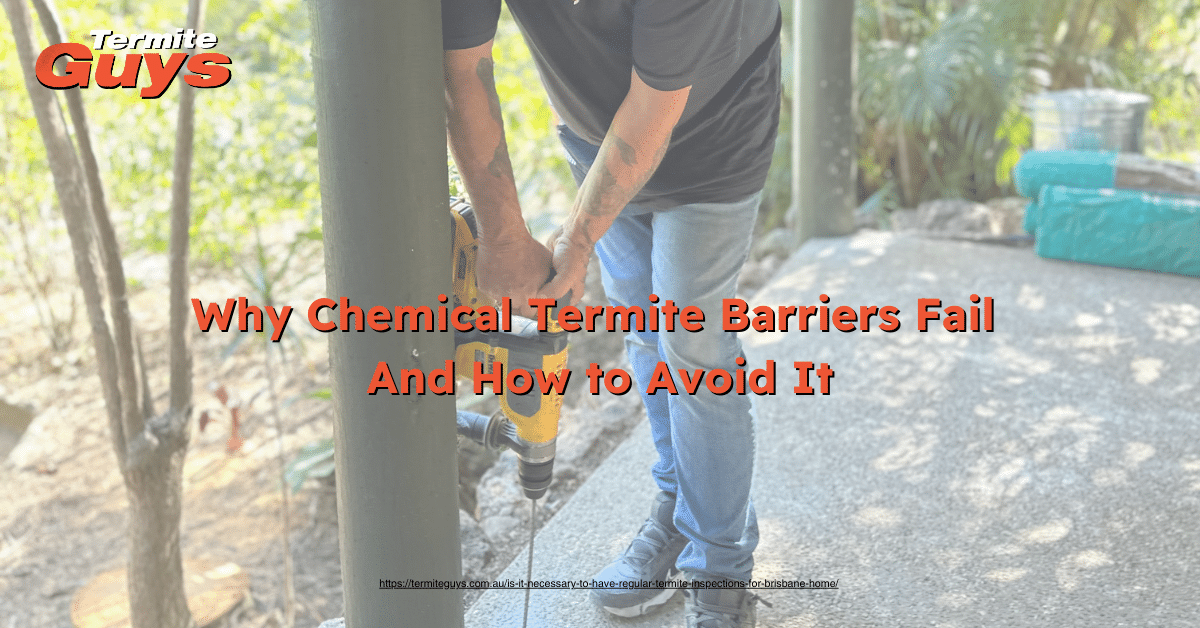
WHY CHEMICAL BARRIERS FAIL | THE GUIDE
Chemical barriers are highly effective when installed correctly – but several factors can cause them to fail prematurely.
This guide explains why barriers fail and how homeowners can make sure their protection lasts.
The 10 Most Common Causes of Barrier Failure
1. Incorrect Installation Depth
If trenches are too shallow, the treated soil zone is incomplete.
2. Insufficient Chemical Volume
Some companies cut costs by applying less product than required.
3. Inconsistent Application
Uneven distribution creates holes in the barrier.
4. Soil Disturbance After Installation
New plumbing, garden beds, or drainage works break the treated zone.
5. Concrete Added Post-Installation
New slabs must be drilled and treated – most homeowners don’t realise this.
6. Moisture & Flooding
Water moving through the soil weakens the chemical.
7. Using Repellent Chemicals
Old-style repellents do not stop colony spread.
8. Untreated Active Termite Nests
Barriers don’t kill colonies already inside the structure.
9. No Annual Inspections
Barrier health must be checked yearly.
10. Natural Soil Movement
Cracking, erosion, or tree roots create pathways.
Early Warning Signs of Barrier Failure
Mud tubes appearing near slab edges
Increased ant or termite presence outdoors
Soft flooring or hollow sounding skirting
Landscaping changes near foundations
CALL TO ACTION
Think your barrier might be failing? Get a professional reassessment.
📞 07-3393-3515
🌐 Book a barrier inspection: https://termiteguys.com.au/
FAQs – Barrier Failure
1. Can a barrier be repaired?
Yes—technicians can re-treat specific sections.
2. Should the entire barrier be replaced?
Only if damage is extensive or treatment is older than 7-8 years.
3. Can I add a new garden bed over a barrier?
Not without re-treating the soil – always ask first.
4. Should I worry if termites appear inside after installation?
Yes – this may indicate a pre-existing nest or a breach.