

Why Baiting is the Smart Choice for Brisbane Homes in 2026
Protect your home with professional termite baiting in Brisbane. We install and monitor termite baiting systems for homes across Brisbane and the Southside, especially where chemical barriers are impractical, incomplete, or less suitable.
Who Is This For!
- homes with landscaping or paving interruptions
- properties requiring ongoing termite monitoring and baiting
- Ideal for difficult sites (sloped blocks) and high-risk homes
- homeowners wanting long-term management
- Brisbane and Southside service area
- Free termite assessment
Brisbane’s unique topography – from the steep ridges of Paddington to the expansive clay soils of the Bayside – presents specific challenges for termite management.
1. Total Colony Elimination (The “Trojan Horse” Effect)
Unlike liquid barriers that act as a repellent to keep termites out, baiting systems are designed to be found. Termites feed on the highly palatable bait and carry the active ingredient back to the central nest.
The Result: The entire colony, including the Queen, is eliminated. You aren’t just shifting the problem to your neighbor’s yard; you are removing the threat entirely.
2. Built for the Brisbane Landscape
If your home is built on a slope or has heavy sandstone retaining walls, a continuous liquid soil treated zone is often physically impossible to install correctly.
The Advantage: Baiting systems require no invasive trenching or slab drilling. They are discreet, flush with your turf, and unaffected by the heavy Brisbane storm runoff that can compromise soil-based chemicals.
3. 2026 “Always Active” Technology
We utilize the latest Active-on-Application (AoA) technology. Gone are the days of “monitoring” empty plastic shells.
Constant Protection: Our stations contain high-density cellulose bait from day one. Your home is protected 24/7, 365 days a year, from the moment we leave your driveway.
Why Brisbane Homes Need a Smart Termite Baiting Strategy
Brisbane termite pressure
Brisbane properties face ongoing termite pressure because the local climate gives termites exactly what they need to stay active for long periods of the year. Warm temperatures, seasonal humidity, and regular rainfall all help create conditions where termite colonies can grow, forage, and spread without drawing attention until damage is already underway.
This is why termite risk is not limited to one style of home or one suburb. Queenslanders, slab homes, homes with extensions, houses built on sloped blocks, and even homes with limited access around the perimeter can all be exposed. Termites do not choose a property based on whether it looks old or new. They respond to moisture, hidden entry points, timber contact, and areas where they can move undisturbed.
A smart termite baiting strategy matters in Brisbane because termite activity can be persistent rather than occasional. Instead of waiting for visible signs of damage, baiting provides a proactive way to intercept termite movement around the property. That gives homeowners a better chance of identifying pressure early and reducing the risk of a major infestation taking hold unnoticed.
Why local homes are vulnerable
Many Brisbane homes are vulnerable because of the way they are built, altered, or positioned on the block. Queenslanders often have subfloor areas, timber elements, and structural features that can create concealed access points if regular monitoring is not in place. Slab homes may appear more secure, but termites can still enter through cracks, service penetrations, expansion joints, and hidden edges where activity is hard to detect.
Homes with extensions can be especially vulnerable when old and new building sections meet. These transition points sometimes create gaps, changes in moisture flow, or construction details that are easier for termites to exploit. A house may seem solid from the outside, but if there are concealed junctions or inconsistent termite protection between building stages, the risk can increase significantly.
Sloped blocks can also create hidden challenges. Uneven ground levels, retaining walls, drainage issues, and difficult-to-see subfloor or perimeter areas can all make inspections and protection more complicated. The same applies to homes with limited access around the perimeter, where dense landscaping, narrow side passages, stored materials, or structures close to external walls can restrict visibility and make termite movement harder to spot early.
This is why a one-size-fits-all approach rarely works. Local homes need a termite baiting strategy that considers how the property is actually built, where termites are most likely to approach from, and which areas need consistent monitoring over time.
Why Southside conditions matter
Southside Brisbane properties often face conditions that make termite management even more important. Many areas include a mix of established suburbs, older timber homes, renovated properties, leafy streets, and blocks with gardens, fences, retaining structures, and moisture-prone zones. These features can create the kind of sheltered, attractive environment termites look for when foraging near a home.
For Queenslanders and older character homes across the Southside, timber components and raised construction can add to the need for a carefully planned baiting system. For slab homes and renovated family homes, landscaping, drainage patterns, patios, and extensions may create concealed pathways termites can use without being noticed. On sloped blocks, water runoff and shaded ground conditions may also contribute to the kind of moisture imbalance that supports termite activity.
Southside conditions matter because termite pressure is shaped by the local environment around the home, not just the home itself. Neighbouring vegetation, fencing, tree stumps, stored timber, garden beds against walls, and limited perimeter access can all increase vulnerability. A smart baiting strategy takes these site-specific conditions into account so protection is based on real risks, not guesswork.
That local understanding is important because the best termite strategy for one Brisbane property may not be right for another. Homes in the Southside need solutions tailored to their layout, access limitations, and surrounding conditions if owners want long-term confidence.
Why waiting is risky
Waiting is risky because termites are rarely obvious in the early stages. By the time damage becomes visible, the colony may have already been active for months or longer behind walls, under floors, around extensions, or through concealed entry points. What looks like a small issue on the surface can quickly become a much more expensive structural problem.
This is especially concerning for Queenslanders, homes with extensions, and properties on sloped blocks where concealed areas can make activity harder to notice. Even slab homes can be at risk when termites enter from below or through hidden cracks and joints. Homes with limited access around the perimeter are also more likely to have blind spots where termite movement goes undetected if there is no active monitoring system in place.
The longer a homeowner waits, the fewer options they may have to catch termite pressure early. Delaying action can mean more damage, more repair costs, more disruption, and more uncertainty about how far the problem has spread. No homeowner wants to find out too late that termites have been working away unnoticed while they assumed everything was fine.
A smart termite baiting strategy helps shift the approach from reactive to proactive. Rather than waiting for termites to reveal themselves after damage is done, baiting creates an opportunity to monitor pressure, respond earlier, and better protect the property over time. In a city like Brisbane, that can make a major difference to both peace of mind and long-term property protection.
What Is a Termite Baiting System?
A termite baiting system is a system of bait stations placed around a home to detect termite activity and target the colony. Termites find the stations while foraging in the soil, feed on the bait, and transfer it to other termites through the colony. Monitoring checks for termite activity first, while active baiting begins once termites are found.
A termite baiting system is a termite management method that uses strategically placed bait stations around a property to detect termite activity and target the colony before major damage occurs. It is designed to monitor for termites first, then use a slow-acting bait to affect the termites that are feeding and sharing food within the colony.What are bait stations?
Bait stations are purpose-built containers installed in the ground around a home, or sometimes in specific above-ground locations where termite activity has been found. These stations are designed to attract foraging termites and allow a technician to regularly inspect for signs of feeding. They form the backbone of a termite baiting system because they create controlled points where termite activity can be detected and managed.How do termites find them?
Termites find bait stations while foraging through the soil in search of food. Subterranean termites move silently underground and explore wide areas around a property, which is why stations are placed in strategic positions around the perimeter. When termites come across a station, they may begin feeding on the material inside it just as they would with other cellulose-based food sources.How is bait transferred through the colony?
Once termites are actively feeding in a bait station, the monitoring material can be replaced with an active bait. The termites then consume the bait and carry it back through their normal feeding and grooming behaviour. Because termites share food with other members of the colony, the bait can spread beyond the station itself and reach other termites, including those hidden deeper in the colony.What is the difference between monitoring and active baiting?
Monitoring is the inspection stage of a termite baiting system. At this stage, the stations contain material that helps detect whether termites are present and feeding. Active baiting begins only after termite activity is found. This is when the monitoring material is replaced with a termite bait designed to be fed on and transferred through the colony. In simple terms, monitoring looks for termites, while active baiting is the treatment step used once termites are detected.Termite Baiting Stations Installation Case Study in Bayside Brisbane
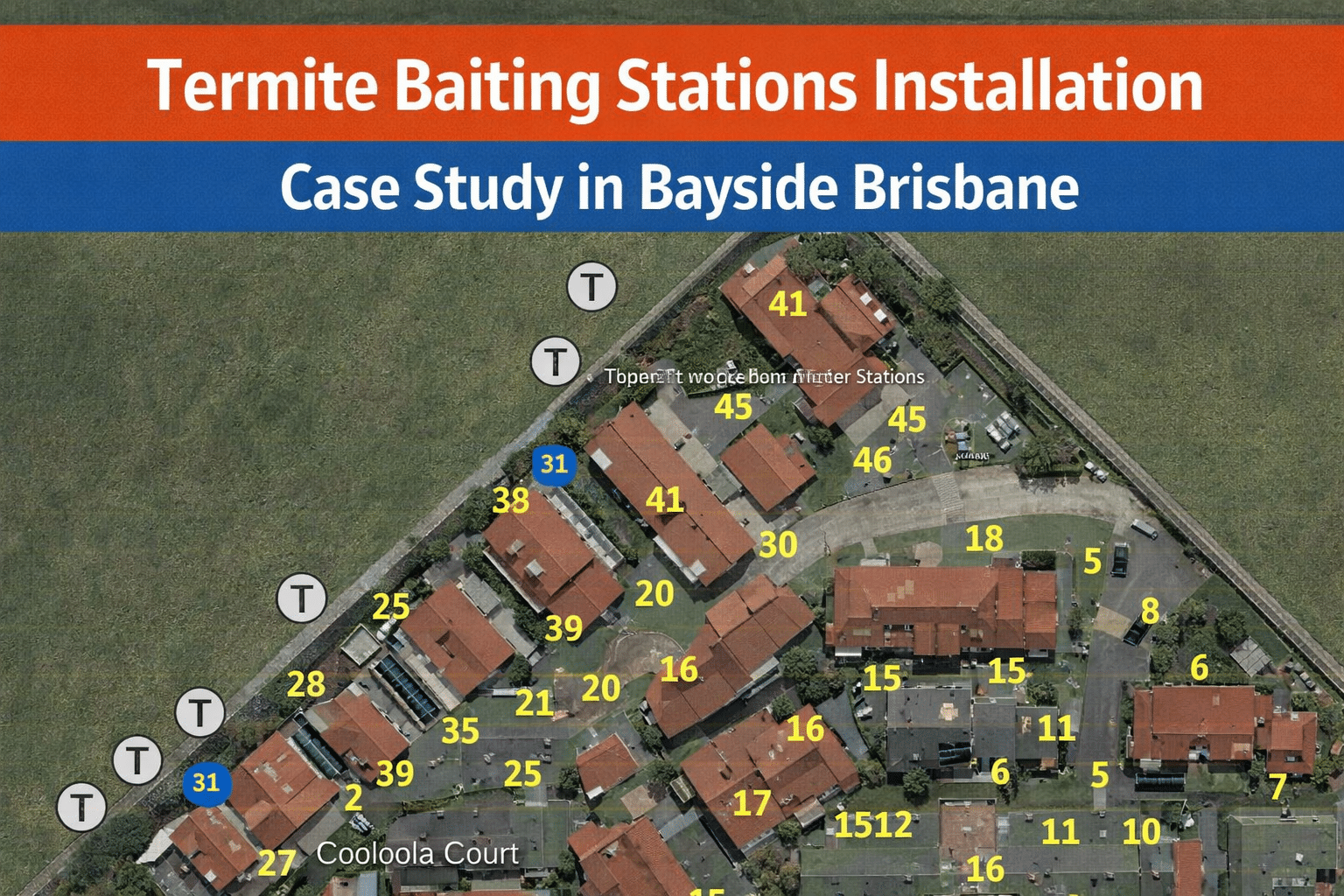
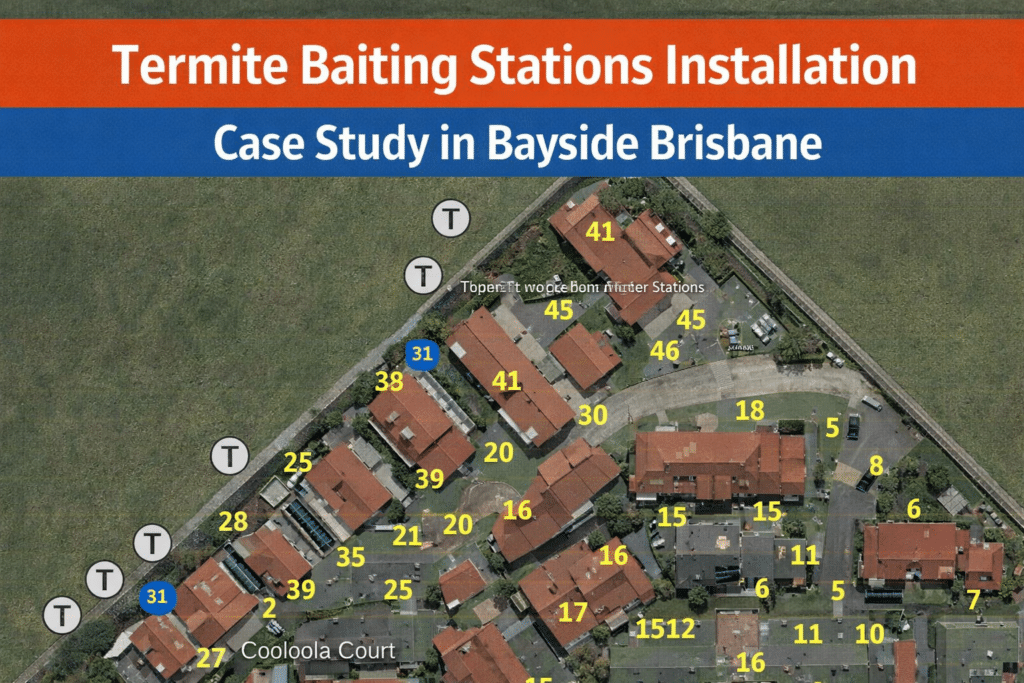
In Wynnum, our team designed a termite baiting station layout for a housing complex of lowset homes to improve long-term termite protection. The bait placement diagram shows an approximate installation plan using Trelona ATBS baiting stations, supported by aggregation boxes, positioned around building edges, shared driveways, and high-risk access points throughout the complex.
This Bayside Brisbane project was planned to create broad coverage across the site, with multiple termite activity markers identified around the perimeter, helping guide where protection was most needed. The diagram indicates a large-scale layout of numbered bait stations across the complex, making it suitable for strata properties, unit blocks, and homeowners wanting a professional termite baiting system installed on their property.
- Wide site coverage: Approximate bait placement was mapped across the full complex for better protection.
- Targeted termite risk areas: Marked termite workings helped identify where monitoring mattered most.
- Ideal for lowset homes: A practical solution for Bayside properties needing termite baiting stations installed.
How Termite Baiting Works
A termite baiting system works by detecting termite activity early, targeting the colony when termites are found, and maintaining regular monitoring over time. The process is simple, strategic, and designed to protect Brisbane homes before major termite damage occurs.
1. We inspect the property and identify termite risk areas
The first step is a professional inspection of the home and surrounding areas. This helps identify where termites are most likely to approach the property and where conditions may make termite activity more likely.
We look at factors such as:
- moisture around the home
- garden beds and landscaping near external walls
- timber contact with soil
- shaded or damp areas
- subfloor access points
- extensions, retaining walls, fences, and other timber structures
This step is important because every property is different. Queenslanders, slab homes, homes on sloped blocks, and homes with limited perimeter access all need a baiting plan based on their layout and risk points.
2. We install termite bait stations in strategic locations
Once the risk areas are identified, termite bait stations are installed in carefully selected locations around the property. These stations are usually placed in the soil around the perimeter where termites are most likely to forage before entering the home.
The goal is to position the stations where they can intercept termite activity as early as possible. Strategic placement matters because bait stations are not installed at random. They are placed based on the structure of the property, the surrounding environment, and the areas most likely to attract termite movement.
This is especially important for homes with extensions, tight side access, uneven ground, or landscaping that affects visibility around the perimeter.
3. We monitor activity and introduce bait when needed
After installation, the stations are checked regularly for termite activity. At this stage, the system is in monitoring mode. That means the stations are being used to detect whether termites are present and feeding.
If termites are found in a station, active bait is introduced. The termites then feed on the bait and carry it back through the colony through their normal sharing and grooming behaviour.
In simple terms:
- monitoring is the detection stage
- active baiting is the treatment stage
This approach allows treatment to begin only when termite activity is confirmed, making the system targeted and responsive.
4. We continue inspections and maintenance for ongoing protection
Termite baiting is not a set-and-forget system. Ongoing protection depends on regular inspections, station checks, and maintenance over time. Conditions around a home can change, and termite pressure can continue throughout the year in Brisbane.
Continued monitoring helps ensure that:
- stations remain in the right locations
- new termite activity is picked up early
- baiting remains effective when needed
- the property stays protected as site conditions change
This long-term approach is one of the key benefits of termite baiting. Instead of waiting until damage is visible, the property is checked consistently so termite activity can be identified and addressed sooner.
Company owner Michael Brewer and his team at Termite Guys Brisbane are extremely professional and definitely better than 5 Star. They are a group of highly skilled people led by someone who is totally committed to the best possible outcome for his clients. All members of the team showed a friendly and helpful manner, which gave us comfort during what was a rather stressful time. Communication throughout the process was excellent. Michael’s many years of extensive experience in the industry was evident by his absolute thoroughness. Whilst installing the termite management system, Michael and Jumbo cleaned up as they went leaving our property spotless. Their finished work is exceptional. We could not be happier and we will definitely be using the ongoing services of this company. We have absolutely no hesitation in recommending Michael and his team at Termite Guys Brisbane“.
When Termite Baiting Is the Right Option
Termite baiting is the right option when a property needs a flexible, targeted termite management strategy rather than a standard one-size-fits-all treatment. It is especially well suited to Brisbane homes where site conditions, building design, access limitations, or existing termite activity make other methods less practical or less effective on their own.
For many homeowners, termite baiting is not just about treating a problem after it appears. It is a smart option when the goal is to monitor termite pressure over time, respond early to activity, and protect the home with an approach that can adapt to the way the property is actually built.
Homes where a full chemical barrier is not practical
Not every home is suitable for a continuous chemical termite barrier. Some properties have construction features, access issues, or surrounding structures that make it difficult to create full, uninterrupted coverage. In these cases, termite baiting can be a strong alternative or part of a broader termite management plan.
This often applies to homes where sections of the perimeter are hard to access, where surfaces are obstructed, or where the layout makes traditional treatment more complicated. Rather than relying on a method that may be limited by the site, bait stations can be placed in strategic locations to monitor termite movement and target activity where termites are likely to forage.
Sloped blocks and difficult site conditions
Homes built on sloped blocks often present extra challenges for termite protection. Changes in ground height, uneven access, retaining structures, drainage flow, and concealed entry points can all make standard treatment methods harder to apply consistently.
Termite baiting is often a good fit for these properties because it allows the management strategy to work with the block, not against it. Stations can be positioned based on the way termites are likely to move around the home, even when the site is not flat or easy to treat evenly. This makes baiting a practical option for homes where terrain affects visibility, access, or treatment continuity.
Properties with drainage issues or moisture-prone areas
Drainage problems are one of the biggest reasons some properties face ongoing termite risk. Areas that stay damp, collect runoff, or hold moisture near the home can create ideal conditions for termite activity. Garden beds, downpipe discharge points, shaded corners, poor surface runoff, and low-lying sections of the block can all add to the problem.
Where drainage issues are present, termite baiting can be a smart option because it provides an active way to monitor termite pressure around the home. Instead of assuming protection is complete after one treatment, baiting supports ongoing checks in areas where moisture conditions may continue to attract termite movement.
Homes where paths, retaining walls, garden beds, or structures interrupt barrier continuity
Some properties have physical features that can interrupt the continuity of a traditional termite barrier. Concrete paths, driveways, retaining walls, paved areas, garden beds against the house, patios, steps, and built structures around the perimeter can all affect how easily a full barrier can be applied and maintained.
In these situations, termite baiting may be the better option because it does not depend on one continuous treated zone around the entire home. Instead, it uses strategically placed stations to intercept termite activity in the areas termites are most likely to travel. This can be particularly useful for homes with complex landscaping or extensions that have changed the original perimeter access.
When active termites are found and a colony-based approach is preferred
Termite baiting is often the right option when active termites have already been found and a colony-based approach is preferred. Rather than only focusing on the point where termites are visible, baiting is designed to work through the termite colony by allowing feeding termites to carry bait back through their normal sharing behaviour.
This can make baiting an appealing choice when homeowners want a method that targets termite activity more broadly, rather than only addressing the immediate area where termites were discovered. Where site conditions allow, this approach can be especially valuable for properties with concealed termite access or situations where the source of the activity is not limited to one obvious location.
Clients who want ongoing monitoring and long-term peace of mind
For many Brisbane homeowners, termite baiting is the right option because they do not want to rely on a once-off treatment alone. They want an ongoing system that helps detect termite activity early and keeps the property under regular review.
This is especially relevant for clients with high-value homes, older properties, Queenslanders, homes with extensions, slab homes, or houses in areas with known termite pressure. Ongoing monitoring gives homeowners more confidence that termite activity will be picked up sooner, before major structural damage occurs.
It also suits property owners who understand that termite risk can change over time. Landscaping changes, moisture issues, renovations, storage, and seasonal conditions can all alter how vulnerable a home becomes. A baiting system with regular inspections helps ensure the strategy stays current as the property changes.
Why the right choice depends on the property
The best termite solution depends on the specific home, the block, and the surrounding conditions. Termite baiting is often the right option when a full chemical barrier is not practical, when access is limited, when moisture or drainage issues are present, when the perimeter is interrupted by structures, or when homeowners want a monitored, colony-based approach.
In short, termite baiting is ideal for properties that need flexibility, ongoing monitoring, and a strategy tailored to real-world site conditions. For many Brisbane homes, that makes it a highly practical and commercially sensible choice.
When a Chemical Barrier May Be Better Than Baiting
A chemical termite barrier may be the better option when the property allows for a continuous treatment zone and the goal is to create broad, immediate protection around the structure. While termite baiting is highly effective in many situations, the right solution is not always the same for every home. The best approach depends on how the property is built, how accessible the perimeter is, the level of termite pressure, whether active termites are present, and whether full barrier continuity can realistically be achieved.
Including this comparison is important because good termite advice should be based on the property, not just the treatment being sold. In some cases, a chemical barrier is the more practical and efficient choice. Explaining that clearly helps homeowners make a more informed decision and shows that the recommendation is based on experience, not bias.
When barrier continuity is achievable
A chemical barrier is often the stronger option when a continuous treated zone can be installed around the home. This matters because chemical barriers work best when termites are forced to encounter the treated area before entering the structure.
If the external perimeter is accessible and uninterrupted, a barrier can provide strong protection across a broad section of the property. Homes without major obstructions around the foundation, and properties where the soil and structural edges can be treated consistently, may be well suited to this approach.
In simple terms, when barrier continuity is achievable, a chemical barrier can be a very effective solution because it creates a direct line of defence between the ground and the home.
When the construction type suits a barrier treatment
Construction type plays a major role in deciding whether a chemical barrier may be better than baiting. Some homes are simply more suitable for barrier installation because of the way they are built and how easily the treatment zone can be established.
For example, a home with straightforward perimeter access and construction details that allow consistent treatment may be a better candidate for a chemical barrier than a home with multiple additions, irregular footing lines, or difficult access points. In some properties, the structure makes barrier application more predictable and easier to maintain over time.
This is why construction type should always be assessed before recommending a treatment method. The goal is not to push one service over another. The goal is to choose the solution that best fits the way the home is actually built.
When access around the home is clear and practical
Access is another key factor. A chemical barrier may be the better choice when technicians can reach the critical treatment areas around the home without major interruption from paths, retaining walls, garden beds, patios, stored items, or structures built hard against the perimeter.
Where access is clear, the treatment can usually be installed more consistently and with fewer compromises. That can make a barrier a practical option for homes where the perimeter is open enough to support the method properly.
By contrast, baiting is often preferred when access is limited or the perimeter is too interrupted for reliable barrier continuity. Being honest about that difference helps build trust because it shows the recommendation is based on site conditions, not guesswork.
When termite pressure calls for a broad defensive treatment
In some situations, termite pressure around a property may support the case for a chemical barrier, especially where the aim is to establish a wide protective zone around the home. If the property is in an area of known termite activity and the site is suitable for treatment, a barrier can be an efficient way to reduce the risk of concealed entry through the soil.
This does not mean baiting is less valuable. It simply means that in certain homes, a barrier may offer a more direct form of structural protection because it is designed to defend the building perimeter itself. The right choice depends on both the termite pressure and the practicality of installing the treatment correctly.
When there is no current termite activity and prevention is the main goal
If there is no current termite activity and the homeowner’s main goal is preventative protection, a chemical barrier may sometimes be the preferred option, provided the property is suitable for continuous treatment. In this situation, the barrier can act as a preventative measure by protecting the structure before termites are found actively feeding near the home.
By comparison, termite baiting works through monitoring and colony-based response, which may be ideal in many homes, but some property owners prefer a preventative treatment that is applied directly to the areas termites are most likely to cross. When there is no active infestation and barrier continuity is possible, that can make a chemical barrier an appealing choice.
When current termite activity changes the recommendation
Whether active termites are present can also influence the best recommendation. In some cases, if active termites are found, a colony-based baiting approach may be preferred because it is designed to target termites through their feeding behaviour. In other cases, where current activity is not the main issue and the focus is long-term structural protection, a chemical barrier may be more appropriate.
This is exactly why a proper assessment matters. The presence or absence of active termites changes the strategy. A trustworthy recommendation should always take that into account rather than assuming the same treatment suits every scenario.
Why the right solution depends on the property
The best termite protection method depends on several factors working together. These include the construction type, how much access there is around the home, the termite pressure in and around the property, whether there is current termite activity, and whether full barrier continuity can be achieved.
When those factors support a continuous and practical application, a chemical barrier may be better than baiting. When they do not, baiting may be the smarter option. In some cases, the best recommendation may involve combining methods as part of a broader termite management plan.
That kind of honest comparison does not weaken the service. It strengthens trust. Homeowners want to know that the advice they are receiving is based on what will genuinely protect their property. Showing when a chemical barrier may be the better choice demonstrates experience, balance, and a commitment to recommending the right solution for the home.
Termite Baiting vs Chemical Barriers: Which Option Is Better for Your Brisbane Home?
The right termite protection method depends on your home, site conditions, and the level of termite risk. This comparison can help Brisbane homeowners understand when termite baiting systems may be the better choice and when a chemical barrier may be more suitable.
| Factor | Termite Baiting Systems | Chemical Barriers |
|---|---|---|
| How it works | Uses stations to intercept termites and deliver bait back to the colony. | Creates a treated zone around the home to block or kill termites as they enter. |
| Best suited for | Homes with difficult access, sloped blocks, landscaping, paths, or areas where a continuous barrier is hard to achieve. | Homes where a full and continuous treatment zone can be installed around the structure. |
| Ongoing monitoring | Yes. Stations need regular inspections and maintenance for continued protection. | Usually less frequent than baiting, but regular termite inspections are still essential. |
| Colony impact | Can target the termite colony through bait transfer. | Mainly acts as a protective zone rather than targeting the whole colony. |
| Installation conditions | Useful where soil access is limited or site conditions make barrier work difficult. | Most effective where access and construction allow a continuous treated zone. |
| Speed of protection | Can be very effective, but results depend on termite discovery and bait feeding activity. | Usually provides immediate protective coverage once correctly installed. |
| Maintenance commitment | Higher. It is an active management system that relies on regular checking. | Lower day-to-day involvement, but inspections and renewal timing still matter. |
| Good option for active termites | Often suitable where colony-based control is needed, depending on the situation. | May also be used, depending on the construction type and treatment strategy. |
| Ideal for Brisbane Southside homes? | Often a practical option for homes with slopes, retaining walls, gardens, paving, and access limitations. | Often suitable for homes where the perimeter allows complete and continuous treatment. |
| Best choice overall | Best where monitoring, flexibility, and colony targeting are priorities. | Best where immediate perimeter protection and barrier continuity are achievable. |
Every property is different, which is why we recommend a professional termite assessment before deciding on the best protection method. In many Brisbane homes, the right solution may depend on site access, construction style, termite activity, and long-term management goals.
Termite Baiting for Brisbane Southside Homes
Termite baiting is often a practical long-term option for homes across Brisbane Southside, where site conditions can make termite management more complex. In suburbs such as Carindale, Camp Hill, Holland Park, Mount Gravatt, Sunnybank, Rochedale, and Eight Mile Plains, many properties have landscaping, extensions, retaining walls, sloping ground, or access limitations that can affect how termite protection is planned.
The same applies in areas like Belmont, Tingalpa, Wynnum West, Manly West, Capalaba, the Redlands, and Logan, where homes may have interrupted perimeters, drainage concerns, garden beds against walls, or structures that make a one-size-fits-all approach less suitable. In these situations, termite baiting systems can provide a flexible way to monitor termite activity and respond early when pressure is detected.
For Southside homeowners, the benefit of termite baiting is that it can be tailored to the property’s layout and ongoing risk. Rather than relying on a generic solution, baiting offers a strategic approach for homes where slopes, site access, and surrounding structures make long-term monitoring and targeted protection especially valuable.
What Types of Properties Suit Termite Baiting Systems?
Termite baiting systems suit a wide range of Brisbane properties, especially where building design, site conditions, or access limitations make termite risk harder to manage with a simple one-size-fits-all approach. They are often a practical option for homes that need ongoing monitoring, flexible placement, and a termite management strategy tailored to how the property is actually built and used.
Queenslander and character homes
Queenslander and character homes often suit termite baiting systems because they commonly include timber features, raised construction, subfloor areas, and older structural details that can create multiple termite risk points. These homes may also have renovations, additions, or altered sections that make termite protection more complex than it first appears.
A baiting system can be a strong fit because it allows termite activity to be monitored around the property over time rather than relying on a generic treatment approach. For older homes with concealed entry points or varying construction elements, that flexibility can be especially valuable.
Sloped block homes
Homes built on sloped blocks are often well suited to termite baiting systems because uneven ground levels, retaining walls, drainage patterns, and hard-to-access areas can make termite management more challenging. Sloping sites can also create concealed approach points where termite activity is harder to spot early.
With termite baiting, stations can be installed in strategic locations based on the layout of the block and the way termites are likely to move around the home. This makes baiting a practical option for properties where terrain affects visibility, access, and treatment planning.
Homes with restricted perimeter access
Homes with restricted perimeter access often suit termite baiting systems because not every property has a clear, open boundary around the entire structure. Paths, retaining walls, garden beds, fences, patios, storage areas, air-conditioning units, and narrow side access can all make perimeter protection more complicated.
In these situations, termite baiting offers a more adaptable solution. Instead of depending on one continuous treatment zone, stations can be positioned in the most practical and high-risk areas around the property. That makes baiting especially useful for homes where access limitations need to be worked around carefully.
Investment properties and ongoing management plans
Investment properties can also be a good fit for termite baiting systems, particularly when the owner wants a long-term termite management plan with ongoing monitoring. Rental properties are not always inspected by the owner regularly, which means early signs of termite activity can be easier to miss without a structured system in place.
A baiting program supports routine checks and ongoing maintenance, which can give landlords and property managers greater confidence that termite pressure is being monitored consistently. This makes baiting a practical option for owners who want proactive protection rather than waiting for damage to become obvious.
Homes with previous termite history
Homes with previous termite history are often strong candidates for termite baiting systems because past activity is a clear sign the property has already been exposed to termite pressure. Even after treatment, homes with a termite history may still benefit from continued monitoring to help detect future activity as early as possible.
For these properties, baiting can provide added peace of mind by creating an ongoing system for checking termite pressure around the home. Rather than assuming the risk has disappeared, homeowners can take a more proactive approach and keep the property under regular review.
Why property type matters
The right termite solution depends on the property itself. Queenslander homes, sloped block homes, homes with limited perimeter access, investment properties, and homes with previous termite history can all suit termite baiting systems because they often need a more flexible and closely monitored approach. When termite risk is shaped by access, construction, or site conditions, baiting can be a highly practical long-term option.
Are Termite Baiting Systems Safe for Pets and Children?
Termite baiting systems are generally considered a safe termite management option for homes with pets and children when they are installed and maintained correctly by a qualified professional. The stations are enclosed, tamper-resistant, and placed in the ground or in controlled locations around the property, which helps limit direct access during normal day-to-day use.
In most cases, pets and children do not come into contact with the bait itself because it is contained inside the station. That said, homeowners should still avoid disturbing the stations and should follow any advice provided by their termite professional after installation.
One reason many Brisbane homeowners choose termite baiting is that it offers a targeted approach. Rather than applying a broad treatment across the entire property, the system works through monitored stations placed in strategic locations where termite activity is most likely to occur.
If you have pets, small children, or specific safety concerns, the best step is to ask for clear advice based on your property layout and the type of system being installed. A professional termite technician can explain where the stations will go, how they work, and what simple precautions to follow for peace of mind.
How Often Do Termite Bait Stations Need to Be Checked?
Termite bait stations need to be checked regularly because baiting is an ongoing termite management system, not a set-and-forget product. The exact schedule can vary depending on the property, the level of termite pressure, and whether termites are already active, but regular inspections are essential for the system to work properly.
Initial monitoring frequency
In the early stage, bait stations are usually checked more frequently so termite activity can be detected as soon as possible. This initial monitoring period is important because the stations need to be inspected often enough to see whether termites have started feeding and whether the system needs to move from monitoring to active baiting.
If termites are found, follow-up visits may become more frequent for a period so the bait can be managed correctly and the activity can be tracked closely. Early monitoring helps make sure the system responds at the right time rather than missing the window when termites first enter a station.
Ongoing maintenance
Once the system is established, ongoing maintenance is still necessary. Bait stations need regular professional checks to confirm they remain in good condition, are positioned correctly, and are still providing effective monitoring around the home.
Over time, site conditions can change. Landscaping, moisture, drainage, soil movement, renovations, and access around the property can all affect termite risk. Ongoing maintenance helps ensure the baiting system continues to match the conditions of the property rather than being left unchecked for too long.
Why follow-up matters
Follow-up matters because termite baiting only works well when activity is monitored and responded to properly. If stations are not checked often enough, termite activity may be missed, bait may not be introduced at the right time, or changes around the home may reduce the effectiveness of the system.
Regular follow-up also gives homeowners confidence that the property is still being actively protected. Instead of waiting until visible damage appears, the system is reviewed consistently so termite pressure can be picked up earlier and managed sooner.
Baiting is a system, not a set-and-forget product
This is one of the most important things homeowners should understand. A termite baiting system is not a one-time product that is installed and forgotten. It is a managed system that relies on inspection, monitoring, follow-up, and maintenance over time.
That ongoing service is what gives baiting its value. The goal is not just to place stations around a home. The goal is to keep checking them, respond when termite activity appears, and maintain protection as the property and surrounding conditions change.
For Brisbane homes, regular station checks are a key part of making termite baiting effective. A properly maintained system gives homeowners a practical long-term way to monitor termite pressure and respond before major damage occurs.
How Much Does Termite Baiting Cost in Brisbane?
The cost of termite baiting in Brisbane can vary depending on the property, the number of stations needed, the monitoring schedule, and whether active termite treatment is required. Because baiting is an ongoing system rather than a one-off product, the total cost usually reflects both the initial setup and the follow-up servicing needed to keep the system effective.
What affects the cost of termite baiting?
Several factors can influence the cost of a termite baiting system. One of the biggest is the layout of the property. A larger home or a block with more complex access may require more planning, more stations, and more time to inspect and maintain properly.
Construction type also matters. Queenslanders, slab homes, homes with extensions, and properties on sloped blocks can all present different termite risks and installation requirements. If the site has retaining walls, garden beds, drainage issues, or restricted perimeter access, that can also affect how the system is designed and managed.
Number of stations
The number of bait stations needed is one of the main cost factors. In general, larger properties or homes with more complex perimeters may need more stations to provide effective coverage. A smaller, straightforward block may require fewer stations than a home with multiple sides, difficult corners, landscaping obstacles, or interrupted access around the perimeter.
The goal is not just to install as many stations as possible. The goal is to place the right number of stations in the right locations so termite activity can be monitored effectively.
Size of property
Property size can affect both installation and ongoing servicing costs. A larger block usually means more ground to assess, more potential termite approach points, and more time needed for regular checks. Homes with wider perimeters or more surrounding structures may also require a more detailed baiting plan than a compact suburban lot.
Monitoring schedule
Another important factor is the monitoring schedule. Termite baiting is not a set-and-forget treatment. It relies on regular inspections and follow-up visits to check stations, detect termite activity, and introduce active bait when needed. The frequency of these visits can influence the ongoing cost of the system.
Some properties may only need a standard maintenance schedule, while others may require more frequent checks, especially in the early stages or where termite pressure is higher.
Construction type
The way a home is built can also affect pricing. A simple site with clear access may be easier to set up and maintain than a property with raised sections, extensions, uneven ground, limited side access, or obstructed perimeter areas. Homes with more complex construction features often need a more tailored termite management plan, which can influence overall cost.
Active termite treatment needs
If active termites are already present, the cost may be higher than for a monitoring-only system. This is because the service may involve additional visits, closer monitoring, and the introduction of active bait as part of a colony-based treatment approach. In other words, the needs of a property with current termite activity are different from those of a home using baiting as a preventative strategy.
Why termite baiting is best viewed as a long-term system
When comparing cost, it helps to think of termite baiting as an ongoing protection system rather than a one-time purchase. The value comes from setup, monitoring, follow-up, and continued maintenance over time. That ongoing service is what allows the system to detect activity early and respond when needed.
For Brisbane homeowners, the best way to understand cost is to have the property assessed properly. That way, the recommendation can be based on the size of the home, the number of stations required, the construction type, site access, and whether active termite treatment is needed.
What Happens If Termites Are Already Active?
If termites are already active, the first step is to assess where the activity is happening, how widespread it may be, and what site conditions are affecting the risk. Active termites do not always mean the same treatment is right for every property. The best response depends on the location of the activity, the construction type, access around the home, and whether termite baiting is the most suitable approach for the situation.
We assess the active areas
When active termites are found, the immediate priority is to identify the affected areas and understand the extent of the problem. This may include locating where termite activity has been detected, checking nearby risk points, and looking for conditions that may be supporting the infestation, such as moisture, concealed access, timber contact, or structural entry points.
The visible activity is not always the full picture. Termites may be present in one area of the home but travelling from another location entirely. That is why a proper assessment matters before deciding on the next step.
We determine whether baiting is appropriate
Once the active areas are assessed, the next step is to determine whether termite baiting is appropriate for the property and the current infestation. In some cases, baiting can be a strong option because it works as a colony-based approach, allowing feeding termites to carry bait back through the colony.
In other cases, site conditions, construction details, or the location of the active termites may mean another treatment approach is more suitable, or that baiting should be used as part of a broader strategy. The goal is to choose the method that best fits the home and the termite activity, not to apply the same solution to every situation.
Other treatment approaches may also be needed
Where active termites are present, treatment may sometimes involve more than one approach depending on the site conditions. This can happen when access is difficult, when the active area needs direct attention, or when the layout of the property affects how termite management should be carried out.
For example, some homes may be better suited to a combination of monitoring, baiting, and other termite treatment measures based on the way the structure is built and how termites are moving through the site. This is why a tailored recommendation is important when termites are already active.
We create a treatment and monitoring plan
After the assessment, a treatment and monitoring plan is put in place based on the property and the level of termite activity. This plan should explain what treatment approach is recommended, how the active termites will be managed, what follow-up is needed, and how the property will be monitored going forward.
This is important because treating active termites is not just about responding to what is visible today. It is also about reducing the chance of ongoing or future activity. A clear plan helps make sure the immediate issue is addressed while also giving the property ongoing protection through regular monitoring and follow-up.
Why a tailored response matters
If termites are already active, the right response should be based on evidence, not guesswork. The active areas need to be assessed properly, baiting needs to be considered in context, and the treatment plan needs to reflect the property’s construction, access, termite pressure, and site conditions.
That tailored approach gives homeowners a clearer path forward. Instead of relying on a generic answer, they get a treatment and monitoring strategy designed around what is actually happening at the property.
Brisbane Termite Baiting Case Studies
Termite Baiting Stations Installation Case Study in Ormiston, Brisbane
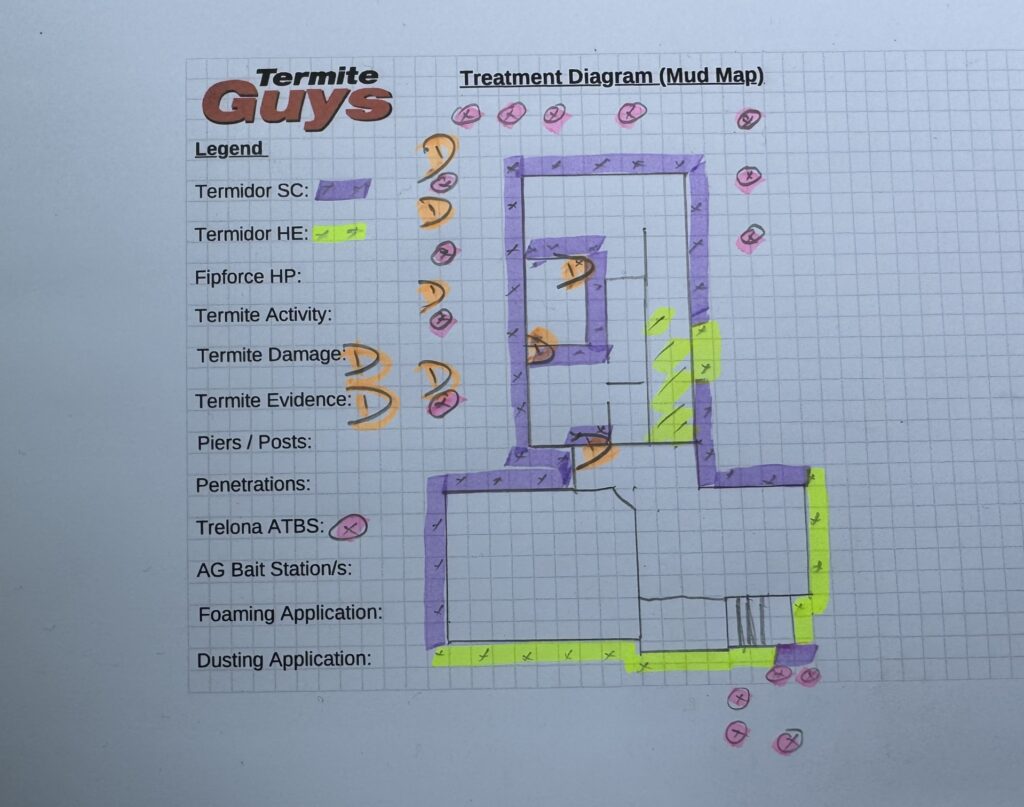
At 5 Dundas Street, Ormiston, we prepared a termite treatment diagram for a residential property in Brisbane’s bayside area that showed a strategic layout for termite baiting stations and treatment zones around the home. The plan highlighted Trelona ATBS bait stations installed around the external perimeter to help create an early warning system and support active termite management for the property.
The diagram also identified targeted treatment areas using Termidor SC and Termidor HE along key sections of the structure, as well as marked zones of termite activity, termite evidence, and suspected termite damage. This made the property a strong example of how baiting stations and targeted treatment can work together when termite pressure is already visible and long-term protection is a priority.
The problem
This property showed clear signs that termite risk was not just theoretical. The treatment diagram marked active termite areas, termite evidence, and suspected damage points around the home, indicating that the property needed more than a basic preventative approach. When visible termite pressure is already present, the main concern is not only the damage that can already be seen, but also the hidden activity that may still be happening in surrounding areas or within the termite colony itself.
Homes in bayside areas like Ormiston can also present conditions that make termite management especially important over the long term. Moisture, surrounding landscaping, perimeter features, and concealed access points can all contribute to termite risk. In this case, the property needed a strategy that could respond to current activity while also helping protect the home moving forward.
Why baiting was chosen
Termite baiting was chosen because the property needed a monitored, strategic system that could address active termite risk around the home’s perimeter. Rather than relying on a single treatment step alone, bait stations were suitable here because they provided a way to detect termite movement early and support colony-based termite management over time.
The use of Trelona ATBS bait stations around the external perimeter was especially relevant because the diagram showed multiple risk points around the structure. Strategic bait station placement helped create an early warning and response system around the home, making it a practical choice for a property where long-term monitoring was just as important as immediate action.
Baiting was also a good fit because this was not a case where homeowners simply wanted a basic preventative treatment. The marked termite evidence and suspected damage suggested a higher-risk environment, which made a more structured termite management plan the better option. For Brisbane homes with visible termite pressure, professionally installed bait stations can form an important part of a broader protection strategy.
What was done
For this Ormiston property, a termite treatment diagram was prepared to map out the recommended bait station layout and treatment zones around the home. Trelona ATBS bait stations were positioned around the external perimeter in strategic locations designed to intercept termite activity before it could spread further or re-enter the structure unnoticed.
In addition to the bait station layout, the diagram identified key treatment areas where Termidor SC and Termidor HE were to be applied along important sections of the structure. This targeted treatment approach supported the baiting system by addressing specific high-risk zones around the building envelope.
The diagram also clearly marked:
- areas of termite activity
- evidence of termite presence
- suspected termite damage points
- strategic bait station placement around the perimeter
- targeted treatment zones for added protection
This combination approach was designed for a property where termite pressure was already visible and where ongoing monitoring would be important after the initial installation and treatment work.
Result and outcome
The outcome was a clear, professional termite management plan tailored to the specific risks of the property. Instead of using a generic treatment layout, the Ormiston case study showed how baiting stations and targeted termite treatment could be coordinated to suit the actual evidence found on site.
By placing bait stations around the perimeter and identifying the most important structural treatment areas, the plan supported both immediate termite management and longer-term protection. This gave the property a more proactive defence against future termite activity and created a system that could support ongoing monitoring over time.
For homeowners, the value of this approach is simple: it helps reduce the chance of termites causing further hidden damage while improving the ability to detect and respond to activity earlier. This Ormiston case study shows how professional termite baiting station installation can be a practical solution for Brisbane homes where termite pressure is already evident and protecting the property for the long term is a priority.
Case Study: Queenslander in Barton Street
Termite Baiting Stations Installation Case Study at 28 Barton Street, Sandgate Brisbane
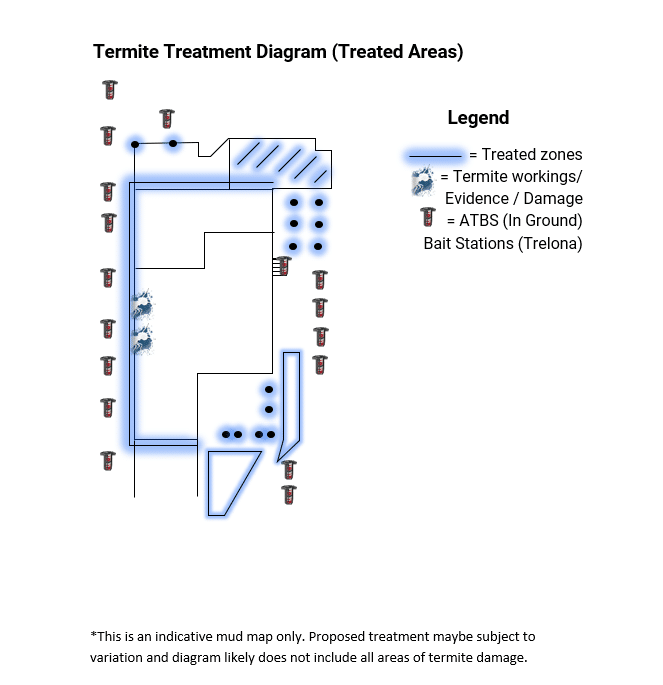
At 28 Barton Street, Brisbane, a final termite treatment diagram was prepared to support a targeted termite baiting station installation around the home. The mud map shows multiple in-ground Trelona ATBS bait stations positioned around the external perimeter, along with treated zones placed against key sections of the structure. This layout was designed to help detect termite activity early, respond to identified risk areas, and support ongoing termite management for the property.
The diagram also highlights termite workings, termite evidence, and damage areas near vulnerable parts of the home, showing why a baiting station system was an appropriate solution in this case. By combining perimeter treated zones with strategically placed termite bait stations, the property benefits from both active protection and long-term monitoring. This is a practical approach for Brisbane homeowners searching for termite baiting stations installation to better protect their property from costly termite damage.
The problem
This property showed clear signs of termite risk that needed more than a basic preventative approach. The treatment diagram marked termite workings, visible evidence, and damage areas near important sections of the home, indicating that termite activity was either already present or had affected the property in vulnerable locations. When this kind of evidence is found, the risk is not limited to the visible areas alone. There may also be hidden termite movement around the perimeter or within nearby structural zones that has not yet become obvious.
For Brisbane homes, this type of situation creates two immediate concerns. First, any current termite activity needs to be addressed properly. Second, the property needs a long-term strategy that helps detect future termite pressure before serious damage can occur. That made this home a strong candidate for a professionally planned baiting and treatment layout.
Why baiting was chosen
Termite baiting was chosen because the property needed a solution that could do more than treat isolated points of concern. A baiting system provides a practical way to monitor termite pressure around the home over time while also giving termites a chance to encounter strategically placed stations before reaching more critical structural areas.
In this case, the presence of termite evidence and damage made ongoing monitoring especially important. Rather than relying on a one-time response alone, the baiting system helped create an early warning network around the home’s external perimeter. This made it a suitable option for a Brisbane property where long-term protection and active termite management were both priorities.
The use of Trelona ATBS bait stations also suited the need for a structured, perimeter-based approach. With multiple stations placed in strategic in-ground locations, the system was designed to improve the chances of detecting termite movement early and supporting future follow-up as part of a broader termite management plan.
What was done
A final termite treatment diagram was prepared to map out the recommended installation points and treatment areas around the home. Multiple in-ground Trelona ATBS bait stations were positioned around the external perimeter in strategic locations, based on the property layout and the identified risk areas shown on the mud map.
Alongside the bait station placement, treated zones were marked against key parts of the structure to provide additional protection in sections considered more vulnerable. The diagram also clearly identified termite workings, termite evidence, and damage areas so the treatment plan could respond directly to the conditions found on site.
The work completed for this case included:
- strategic bait station placement around the home’s perimeter
- marked termite evidence and damage areas to guide treatment planning
- targeted treated zones against key structural sections
- a practical termite management layout designed for long-term monitoring and protection
This combination approach was designed to support both immediate termite management needs and ongoing inspection of termite pressure around the property.
Result and outcome
The outcome was a clear, site-specific termite treatment and monitoring plan tailored to the actual risks identified at the property. Instead of using a generic layout, the final diagram provided a structured approach that combined perimeter bait stations with targeted treated zones in areas where extra protection was needed.
This gave the property a stronger long-term defence by improving the chances of early termite detection and supporting continued monitoring over time. For the homeowner, that means a more proactive system designed to reduce the risk of further hidden activity and help protect the home from future termite damage.
This case study at 28 Barton Street, Brisbane, shows how professional termite baiting station installation can be used as part of a practical, long-term termite management strategy. When termite evidence and damage are already visible, a well-planned baiting layout can play an important role in ongoing protection and peace of mind.
Why Choose Termite Guys for Termite Baiting in Brisbane?
Choosing the right termite company matters because termite baiting is not just about placing stations in the ground. It is about understanding termite behaviour, reading the property correctly, choosing the right treatment approach, and following through with ongoing monitoring. Termite Guys is positioned as a termite-focused Brisbane company that helps homeowners, buyers, investors, and property managers protect their properties with a clear plan and practical advice. The internal writing brief also positions Mike Brewer as the termite inspector guiding clients toward the right long-term solution for their property.
Termite-only specialist focus
One reason homeowners choose Termite Guys is the specialist angle. Rather than trying to be everything to everyone, the brand positioning is built around termite inspections, termite treatment, and long-term termite protection. That matters because termite baiting works best when the company understands termite pressure, site conditions, treatment options, and how to tailor recommendations to the actual risk at the property.
For homeowners, that specialist focus can create more confidence. You are not dealing with a general service that only occasionally handles termites. You are working with a business built around helping Brisbane property owners reduce termite risk and avoid the repair costs that can come when termite issues are missed or neglected.
Experience and local Brisbane knowledge
Local knowledge is a major advantage when it comes to termite baiting. Brisbane homes vary widely in age, design, access, drainage, landscaping, and construction type. Queenslanders, slab homes, renovated properties, bayside homes, and houses on sloped blocks can all present different termite risks. A company that understands Brisbane conditions is better placed to recommend where baiting is likely to work well and when another approach may be more suitable.
Termite Guys run by Mike Brewer, helping owners across Brisbane and interstate buyers protect properties from termite infestations with a long-term plan.
A clear inspection process before recommendations are made
Good termite baiting starts with a proper inspection process. Before stations are installed, the property needs to be assessed for risk areas, access limitations, moisture issues, visible termite evidence, and the way the structure is built. This step helps determine whether baiting is the right fit, where stations should go, and whether other treatment measures should also be considered.
That kind of process builds trust because it shows the recommendation is based on the home itself. The internal guide for Termite Guys emphasises giving clients a plan, helping them take action through an assessment of the property, and then providing a quote based on their situation. That supports a more personalised and professional approach rather than a generic sales pitch.
Digital reporting and documented findings
If digital reporting is part of the service, it adds another layer of confidence for homeowners. Clear reporting helps clients understand what was found, where the risks are, what treatment is recommended, and what follow-up is needed. For termite baiting, that can be especially useful because the value of the system depends on ongoing monitoring, documented checks, and a record of activity over time.
From a trust perspective, documented reporting makes the process easier to understand and easier to act on. Homeowners do not want vague advice. They want clear findings, a practical plan, and a record they can refer back to when making decisions about treatment and future inspections.
Thermal imaging where relevant
If thermal imaging is used as part of the inspection process where relevant, that can further strengthen confidence in the service. Termites are often hidden, and any tool that helps support a more thorough inspection can improve the quality of the assessment. For homeowners, this helps reinforce the idea that the recommendation is based on careful investigation rather than assumptions.
Thermal imaging should still be presented honestly as part of the inspection toolkit, not as a shortcut or a replacement for experience. When combined with a proper on-site assessment and termite expertise, it can help support better-informed treatment recommendations.
Personalised treatment recommendations
Not every Brisbane home needs the same termite solution. Some homes are better suited to baiting. Others may be better suited to a chemical barrier. Some properties may need a combination of approaches depending on current termite activity, access, construction type, and whether barrier continuity is achievable.
The treatment plan recommended for your property is not a one-size-fits-all package.
Ongoing monitoring matters
Termite baiting is only effective when it is monitored properly over time. That is why ongoing monitoring is one of the strongest reasons to choose a professional termite baiting provider. The stations need regular checks, activity needs to be tracked, and the system needs to be maintained as site conditions change.
For homeowners, this ongoing service is a major benefit. It means the property is not simply treated and forgotten. It is kept under review so termite pressure can be picked up earlier and managed more proactively. That kind of follow-up directly addresses common customer concerns such as poor communication, ineffective treatments that do not last, and lack of follow-up after the initial job.
Why this builds trust
For Brisbane homeowners, the message is simple. If you want termite baiting advice based on specialist knowledge, local experience, property-specific inspection findings, and ongoing monitoring rather than a generic recommendation, Termite Guys is positioned to provide that guidance and help you protect your home for the long term.
What Brisbane Homeowners Say About Our Termite Baiting Services
Brisbane homeowners choose us because we provide honest advice, clear termite baiting recommendations, and practical long-term protection. Here is what local clients have said about their experience with our termite baiting services.
Professional advice, Great service, friendly, knowledgeable and a Clear Termite preventative management plan for Brisbane home
Great service, friendly, knowledgeable, thorough and cost efficient. Definitely give this team a go.
I recently relocated to Brisbane from climates where termites are not a thing. I found myself overwhelmed with choices of providers to have my property checked over for termites and a furniture preventative management plan put in place. Unfortunately I found some who were willing to try and take advantage of my lack of knowledge around termites using scare mongering and pressure tactics to have me sign up and commit to over inflated quotes, well into the thousands, with so called “discounts” if I accepted their quote on the spot, glad I didn’t.
I couldn’t be happier that I reached out to the Termite Guys Brisbane.
Thank you👍 ~ Andrew Watson
Effective Termite Inspection for a Forest Lake Home
We have just had Joel from the Termite Guys do an inspection of our home in Forest Lake 4078. Joel was on time, professional with good communications, and we would have no hesitation in recommending him if you need help with termite prevention. ~ John Knott
Honest Service, Clear Communication, and Comprehensive Reports
Joel and the team were fantastic. They conducted a very thorough inspection and delivered a comprehensive report, identifying all potential issues and provided reasonable recommendations. Thanks team for such great service. ~ Jonathan Gupta
Peace of Mind After Installing a Termite Barrier System
Top tier service from the Termite Guys! We had a Termidor chemical barrier installed and everything from quoting to job completion was fantastic. Offering a competitive quote where they will go through everything with you, Termite Guys only do termite-related treatments and inspections (no general pest control) so you can trust they know what they’re doing. Shout out to Joel and Jumbo for their genuine friendliness and professionalism when installing the barrier! ~ Jingable
Frequently Asked Questions About Termite Baiting in Brisbane
What is termite baiting?
Termite baiting is a termite management system that uses in-ground stations placed around a property to monitor and control termite activity. It is designed to attract termites and help protect homes from hidden termite attack over time.
How do termite baiting systems work?
Termite baiting systems work by placing stations in the soil around your home. When termites find the bait, they feed on it and carry it back to the colony, helping reduce termite activity at the source.
Is termite baiting effective for Brisbane homes?
Yes, termite baiting can be very effective for Brisbane homes, especially in high-risk areas where termite pressure is common. It provides ongoing monitoring and can be a strong long-term solution for detecting and managing termite activity.
When is termite baiting better than a chemical barrier?
Termite baiting may be better than a chemical barrier when the property is difficult to trench, has drainage issues, construction limitations, or where a less invasive termite management option is preferred for ongoing monitoring and colony control.
Can termite baiting eliminate an entire colony?
Yes, termite baiting can help eliminate an entire colony when termites actively feed on the bait and transfer it through the nest. Results depend on termite activity, bait discovery, colony size, and ongoing professional monitoring.
How often do termite bait stations need to be checked?
Termite bait stations should be checked regularly by a professional, with frequency depending on site conditions and termite risk. In many cases, stations are inspected every few weeks initially, then monitored on an ongoing schedule.
Are termite baiting systems safe for pets and children?
When professionally installed and maintained, termite baiting systems are generally considered safe for pets and children. The bait is contained within locked in-ground stations, reducing direct access while still allowing effective termite monitoring and treatment.
How much does termite baiting cost in Brisbane?
The cost of termite baiting in Brisbane can vary depending on property size, number of stations needed, site access, and ongoing monitoring requirements. A professional inspection is usually the best way to get accurate pricing.
Can baiting be used if termites are already active?
Yes, termite baiting can be used when termites are already active on a property. In many cases, it forms part of a treatment plan designed to manage current activity while also providing longer-term monitoring and protection.
Do termite bait stations work on sloped blocks or difficult sites?
Yes, termite bait stations can often be installed on sloped blocks and difficult sites. They are a flexible option for properties where traditional barrier treatments may be harder to apply due to access or construction challenges.
What suburbs do you service on Brisbane Southside?
We service a wide range of Brisbane Southside suburbs for termite baiting, inspections, and termite treatment. Coverage can vary, so it is best to contact us to confirm if your suburb falls within our service area.
Do I still need regular termite inspections if I have bait stations?
Yes, regular termite inspections are still important even if you have bait stations installed. Baiting systems are only one part of a termite management plan, and inspections help identify activity, damage, and risks not visible externally.